
Guided self-inquiry with tarot
1:1 tarot sessions in Oslo and online as an imagery-based method for exploring life questions and gaining new perspectives.
A creative way to talk through life questions
Is there a life challenge or decision that you’ve been stuck on for a long time, and talking or writing about it using words has not been helping? Do you feel yourself going in circles, thinking the same thoughts, speaking the same words?
Have you ever tried… taking the thing you’re stuck on, going to a large art museum or gallery, and seeing if anything you’ll encounter there can give you another perspective? How about going with a buddy, who happens to know a lot about how to engage with visual art as a way of getting new perspectives on personal challenges?
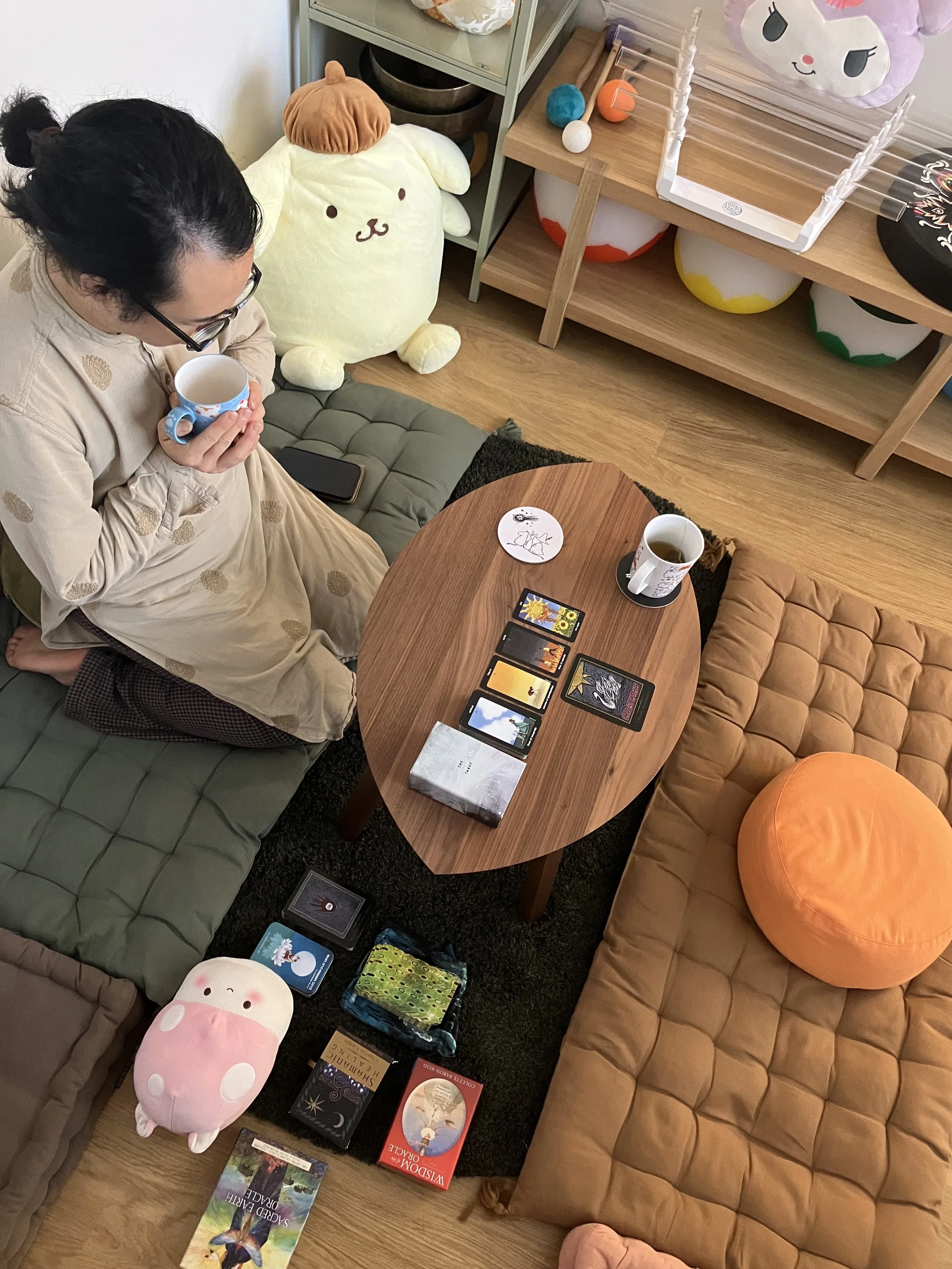
Tarot and oracle decks are kind of like pocket-sized art galleries. I’m the buddy you go with. My goal is for you to feel less stuck, more empowered, and more in touch with your own inner compass by the end of the visit. We will spend time together looking at a “random” configuration of images while being with the challenges or questions you are facing in your life.
Maybe you’ll arrive with a clear sense of what wants to be explored in the session. Other times, something “just feels off” in our bodies or life situation and we don’t fully understand why or how. If neither talking nor writing has been helpful in inviting clarity, processing it through images might be worth a try.
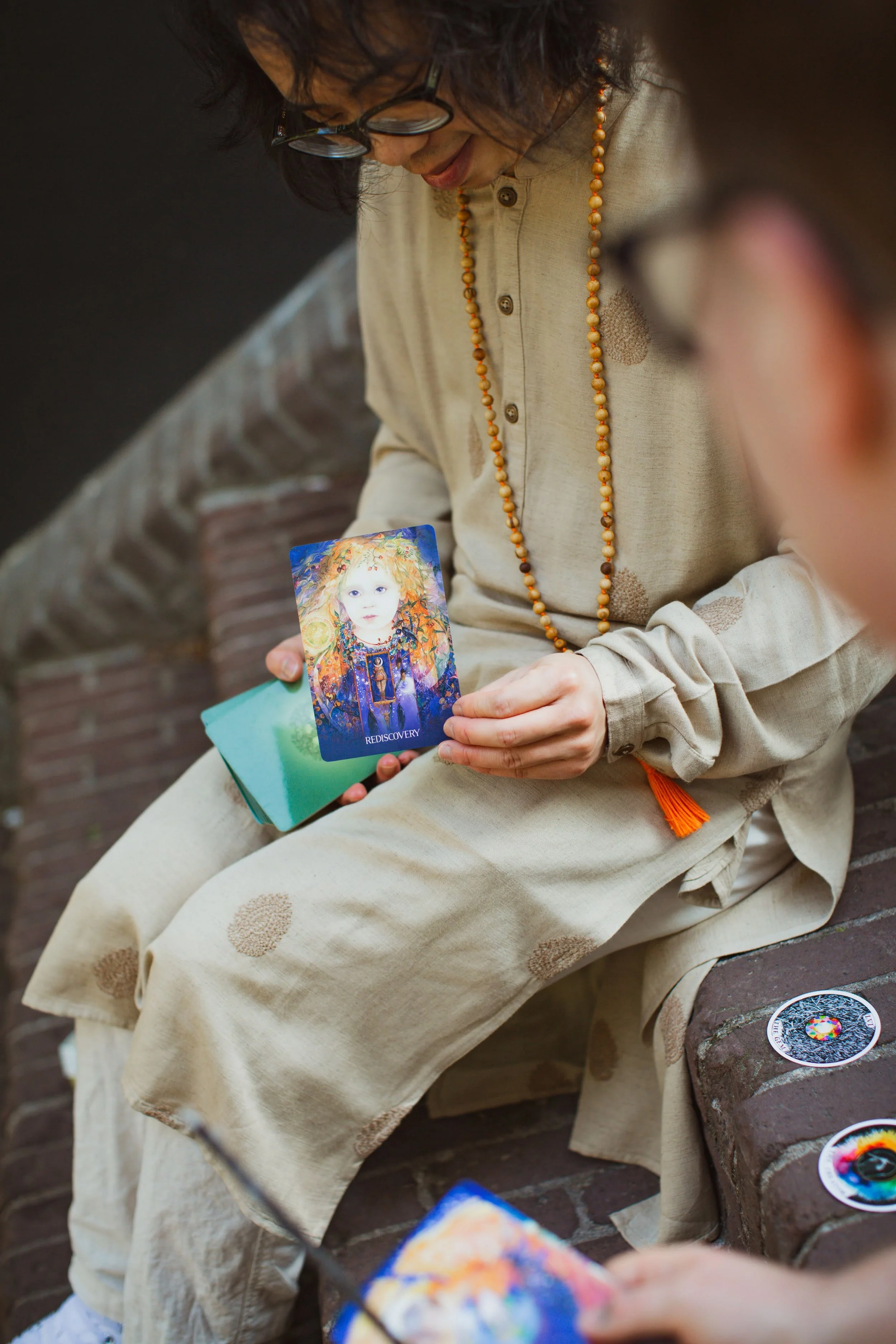
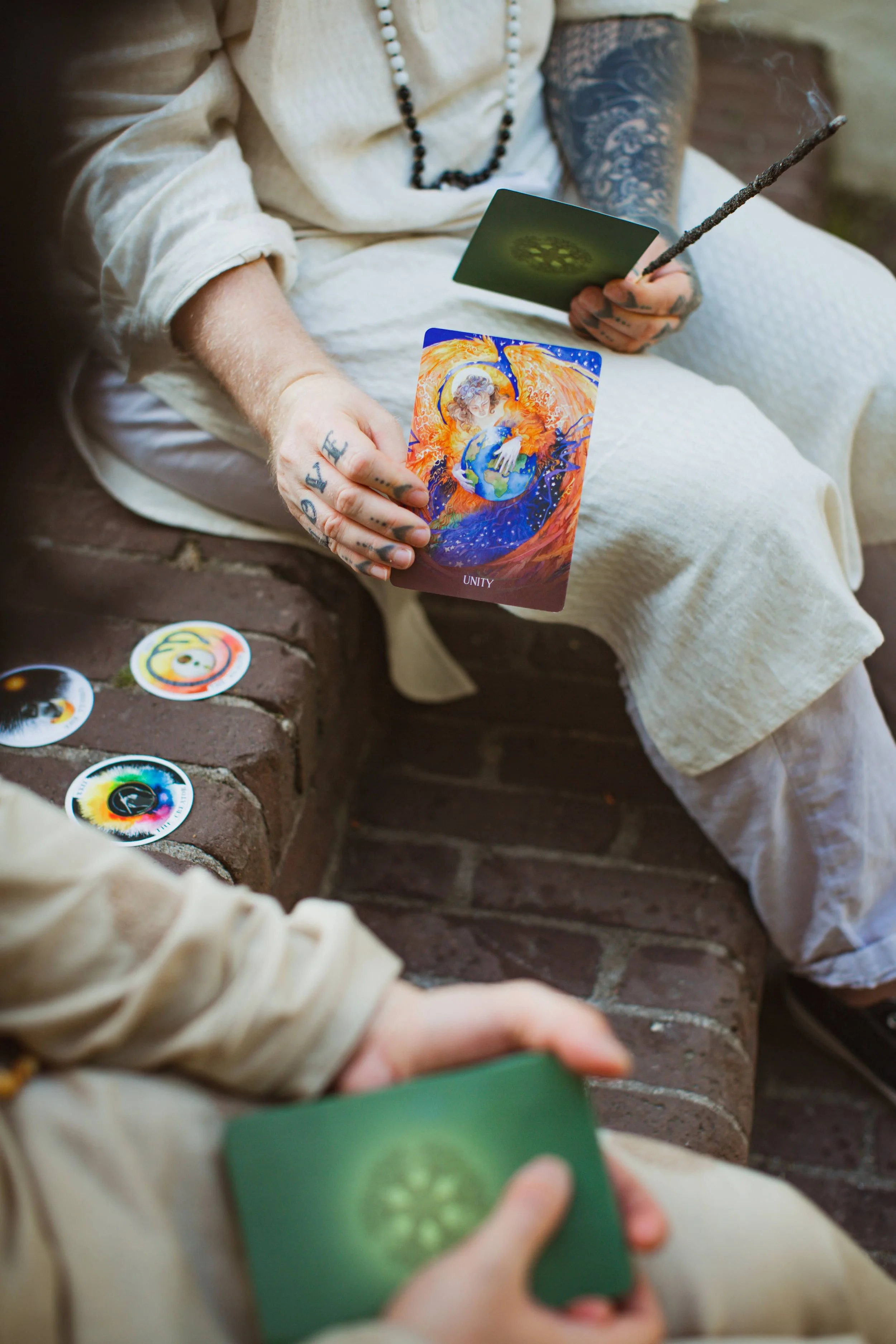
I’ll ask you questions about what you see and notice, as well as share what I see and notice — by pointing them out with my fingers (or a digital pencil), so you see them too. I’ll invite you to notice how your body, mind and heart are being impacted by the different things you see — because that information is important.
Thinking and feeling in images together
I relate to the tarot as a visual-symbolic language system. Long before starting to read for others, I was using tarot cards as a way to process emotional experiences for which words felt lacking and insufficient. This is the base orientation which I bring to this practice: it is not about telling the future or asking questions to a “mystical” source. It is primarily a creative way of getting to know ourselves and our life situation better in the here-and-now.
Tarot sessions with me are about exploring a topic of your choice together, using an imagery-based language system in addition to our spoken language. Images and visual symbols which appear on cards may conjure up different meanings for you than for me, based on our differing personal backgrounds. I hold the perspective that the most valuable information to be gained from this process is what you notice, your somatic and emotional responses, and what meaning you find yourself making — of the images that are present. My perspectives are solely here to support the unfolding of yours, never to contradict or override them.
I will invite you to share your own experience of how the cards which are drawn resonate with you, and focus the session around where your attention goes while weaving in technical details about the meaning of specific cards in the tarot system and their relationship to other cards where it may facilitate deeper exploration or attentional focus. It is a collaborative process of inquiry involving three parties: you, me, and the cards. The cards give us something to look at together, and through dialogue we discover what becomes visible in the meeting between the three.
This might be for you if…
You feel stuck on a challenge, question, or decision and neither talking about it nor writing about it using ordinary linear language is helping;
You have a sense that there is more to understand about a situation, but find yourself circling the same thoughts and perspectives;
You enjoy images, symbolism, visual art and metaphors as ways of thinking, processing and sense-making;
You are interested in trying out new methods of creative thinking and problem solving;
You are curious about tarot but do not want someone else telling you who you are, what you should do, or what your future holds;
You’ve had prior experiences with tarot that did not resonate or felt uncomfortable, and want to give the cards another chance;
You are curious about how tarot can be practiced in a super “skeptic-friendly”.
What happens in a session
Every tarot session follows the same “arc”
Establishing shared ground
Before turning our shared attention towards the cards, I spend some time to arrive in the present moment with you. I’ll ask about things like: what brings you here now, whether you've done anything like this before, what is alive for you in this moment, and whether there is a particular theme or question you'd like to explore.
Choosing and drawing the base picture
You choose the tarot deck we’ll use. Depending on what your theme or question is (if there is one), I might present a selection of 2-3 decks (very occasionally, my entire collection) to choose from. This step is important, but it doesn’t need to be complicated — just choose the art style that you like the most.
Then, I’ll shuffle the cards while inviting you to share a bit more — either about your story, your theme or question, or what’s present in your awareness right now. At some point I’ll ask you to tell me when to stop shuffling. The deck configuration at that point is the one from which we draw.
Seeing, sensing and noticing together
Once the cards are laid out, I always start the exploration process with two questions:
Being with this image, is there anywhere specific that your attention seems to be drawn?
If you allow your attention to focus in on [that], what do you notice happening on the inside?
Most of our time will be spent at this stage of the arc — you sharing what you notice, me sharing what I notice in response to hearing about what you notice, offering reflections and deepening questions. In the very beginning, I keep my observations strictly on the level of visual details that you also can see — colours, shapes, relationships between images, the positions of characters and objects on those cards, their facial and body language, etc. As the exploration evolves, our shared attention will naturally widen to include many different topics which the visual details could feel connected to.
If you are not familiar with the technical details of the tarot system (major/minor arcana, suits, numbers, court cards, etc), I will bring them in at some point as additional information and scaffolding that can help build on or deepen what you are already seeing.
If you are experienced, and already have your own technical map of the territory, I might ask you questions about how that map is shaping what you are perceiving in the present moment, and how particular concepts or frames relate to the images in front of us that we both can see.
Sometimes the conversation might fall silent for a while as we “just are”, together, with the images in front of us.
Change the picture, change your perspective
Unless we have agreed in advance to follow a specific spread, the positions of the cards are never set in stone. Sometimes I will invite you to try changing the positions of a few cards and notice what happens in you as you do so. How is it to be with this new picture? What feels different now? If you could organise these cards any way that you like on the table, how might you do so?
Closing with oracle cards
In the latter half of the session, I’ll invite you to choose an oracle deck, from which we draw the final cards that will complete the picture. We look at the final visual configuration together and allow the conversation to move towards whatever feels important to take away.
In-person sessions take place in my small and cosy home office in Oslo; online sessions can be joined from anywhere.
A note about online sessions
That we both can see the cards visually at a high level of detail, is foundational to the way I work. When you join the video call, there will be another “user” present with its camera and audio off — that’s not a stranger or an AI, that’s my tablet!
Every time cards are laid out or changed, I will take a picture of it and use my tablet to screenshare it with you. This allows me to zoom in and out and draw directly on the image using different colours of my “digital pencil”. For most of the session, we will be looking at the screenshare together.
After the session, I will send you photos of: the entire spread in each configuration, every individual card that was drawn, and all the original booklet pages of the oracle cards that were drawn.
The session can be recorded for your own records upon request.
Ways to experience it
-
60 minute session
A general tarot session is typically one hour. Feel free to bring any themes or questions in your life right now, for which you would like some new perspectives.
Price: 900 NOK / €85
(Want more time to explore a question, or to combine Tarot with another practice? See Extended & Combined Sessions. For ongoing work on a weekly or biweekly basis, reduced rates can also be agreed upon in advance.)
-
Wheel of the Year reading (90m)
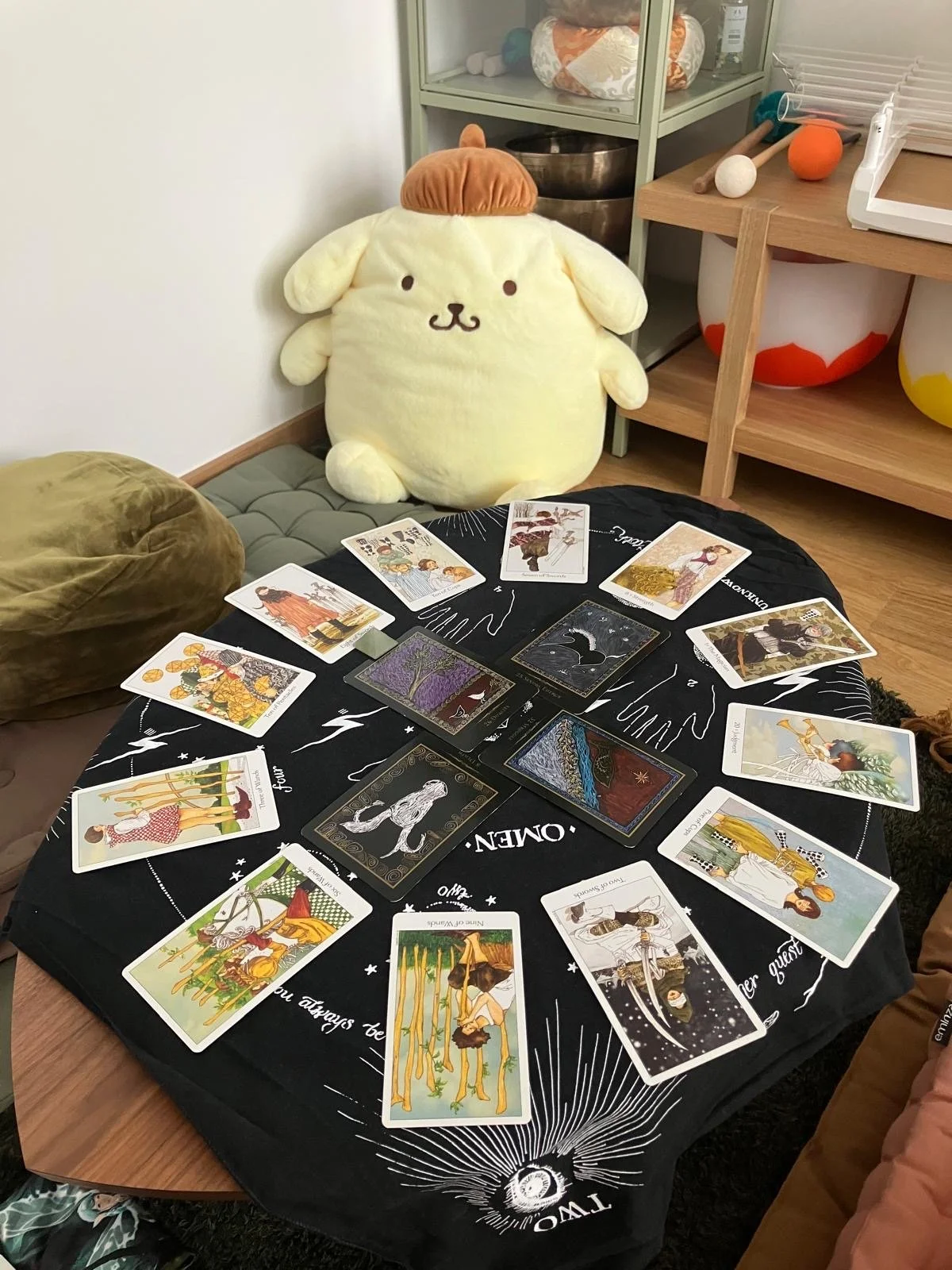
The Wheel of the Year follows the same overall process as the standard session, but uses a larger, defined spread: 12 tarot cards for the 12 months and 4 oracle cards for the seasons, beginning with the current or upcoming month. The cards are not intended to tell you what will happen each month, rather to support you in planning, intention setting, becoming more aware of your own relationship to cycles, seasons, years, and the short- to mid-term “future” in general.
It can be a great opportunity to reconnect with yourself around the new calendar year, birthdays, anniversaries, when starting new projects, etc (or to purchase as a birthday gift for a friend ☺️).
Price: 1200 NOK / €110
Questions
-
I do not use tarot to predict the future or tell you what is going to happen. We can absolutely explore questions about the future, but the purpose is to explore your relationship to the question, rather than discover a fixed future hidden in the cards.
-
Not in the sense of giving you a definitive interpretation of what each card means for your life. I will share things I notice in the imagery and can also bring in my knowledge of the tarot system when useful, but your own observations, associations and responses are central to the process.
If a card doesn't connect with you, that's completely fine. Confusion, resistance, boredom or dislike can also become something interesting to explore.
-
You can come with no previous experience at all. I will explain anything about the tarot system that seems useful as we go, and it is perfectly ok if it feels like “a lot of information at once” and you retain little of what I say about the technical details. Those details are not the most important; your own felt experience is.
If you already know tarot, you are very welcome to bring your own knowledge into the conversation. I may ask you what a particular card or combination usually means for you, and how that understanding is affecting what you notice in the moment.
-
I never use tarot to read another person's mind, energy, intentions or private life without their participation and consent.
Questions that involve other people can of course be explored, but the focus will remain on your own experience, perspective and relationship to the situation.
-
Tarot is not a diagnostic tool, and I don't use it to diagnose health conditions, determine what treatment you need, or give authoritative instructions about how you should live your life.
The purpose of the session is exploration and sense-making, not diagnosis or prescription.
-
There is no fixed schedule; some people come for a single session around a particular question, while others return regularly to continue exploring and deepening.
You can book a session whenever there is something you would like to explore, including on a regular basis if you find this way of talking and thinking through life situations useful.
If we meet on a regular basis, I can also support you to develop your own personal practice of visual imagery-based thinking and processing. You can also bring your own decks and practice reading them for yourself with my guidance.
-
Tarot is a structured card system with a defined set of cards and relationships between them. Most tarot decks share the same basic structure of Major and Minor Arcana, four suits, numbered cards and court cards, even though the artwork and details vary considerably between decks.
Oracle decks do not follow one shared system. Each oracle deck is created around its own set of cards, themes and relationships.
I usually use tarot as the main visual and structural framework of a session, and oracle cards towards the end to introduce another kind of imagery and perspective.
-
Tarot can also be a shared practice rather than a 1:1 session, when the thing you want to explore belongs to more than one person.
This might be a relationship, a shared project, a creative collaboration, a family situation, or another question that you are exploring together with someone else. We use the same basic process: the cards become something that all of us can look at, notice and respond to, while I facilitate the conversation and help anchor the shared attention.
I don't use the cards to tell one person what another person is thinking, feeling or intending. The focus stays on what becomes visible to the people who are actually present, and on the relationship, project or situation you are exploring together.
More people means, access to more perspectives — this is only a good thing! When there are multiple participants, I would recommend a longer session (90 minutes or more) to give everyone enough space to participate in the dialogue.
“And all the voices, all the goals, all the yearnings, all the sorrows, all the pleasures, all the good and evil, all of them together was the world. All of them together was the stream of events, the music of life.”
—Hermann Hesse