Guided self-reflection with tarot cards
On my tarot offerings page, I describe relating to tarot as a visual and symbolic language system. Learning this language radically expanded my own vocabulary — and thus capacity — for processing and integration of intense, confusing, disorienting, as well as transformational life experiences. For everything in life that is “hard to put into words”, which is… a lot. I believe tarot has a tremendous, untapped, unrecognised potential to be a source of support and creativity in so many lives. I believe that everyone can learn this language, everyone can benefit from it, and it is totally compatible with all spiritual and religious identities.
I always start my reading sessions by asking the querent what part of the resulting spread they are most visually drawn to. I consider part of my job as a reader, is to demystify the process, and share my confidence in the ability which we all can develop, for engaging with the cards directly. Even if you’ve never seen tarot cards before — when looking at an image, there will often be some kind of mental association or emotional response — that information is important. It may be an opportunity to learn something new about yourself.
I worked with tarot as a guide for self-reflection, processing and integration — as a way to understand myself better — for many years before I started doing readings for other people. That is something which came much later, once I had developed a confident, fully embodied knowledge of the tarot system through my personal process.
Sometimes people ask me how I learned tarot, or how they can learn tarot. There are 2 challenges I often hear in these discussions:
Feeling like the tarot system is very complicated, and there is a lot to memorise, that makes the learning process feel very “heady”
Feeling apprehensive about the metaphysics of shuffling and drawing cards “at random”: What if “bad cards” keep appearing? What if some cards refuse to ever appear?
Everyone’s learning styles are different, of course. But if that’s you, perhaps it might help to hear about the way I did it.
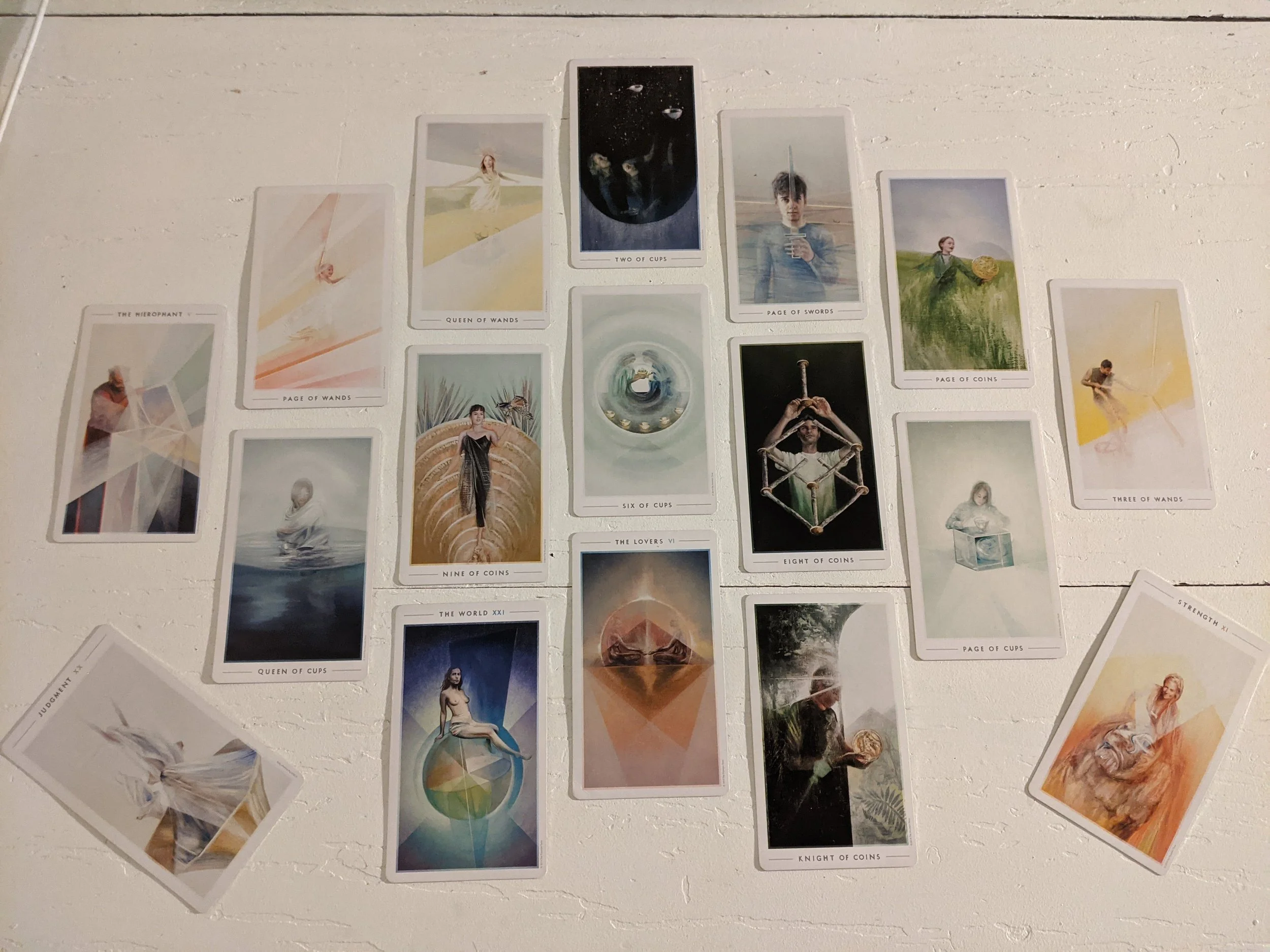
One example of the final result of the practice I will describe below. This picture was taken in 2021. More examples can be found here.
How I started learning this language (and how you can too)
Prerequisite: having access to a physical deck of cards whose visual style you resonate with.
Every time I was feeling something intense, that I could not put into words, and that was affecting me a lot, I picked up my cards and just started looking through them, one by one.
If I found myself being drawn to, or spending a longer than average time looking at one card, I would pull it out of the deck.
After going through the whole deck, I now had a pile of cards, that for some reason felt like they resonated or were important.
The next step is to lay all of them out on the table or floor (or another surface). I am not thinking about it too much here, any layout will do, as long as no card is on top of any other.
With an unobscured view of each card, I take all the time I need to feel into — without words, without any attempt to analyse or interpret — the layout in front of me. The placement of each card in relation to every other one. The energy of the whole, as well as all of its parts.
I will often have spontaneous desires to change the placements or layouts in some way, or even remove some cards altogether. I’m still not thinking about “why” at this point. Simply following, trusting, allowing “what feels right”.
Continuing to be with and feel into the cards in front of me, zooming in and out, until I feel confident that this exact layout is just right, and no more adjustments can be made to make it more right.
Only at this point do I start to actively ask myself what this means. What does each card mean? What do their positions relative to one another mean? Why is this constellation the why it is? What can this tell me about myself and my inner world?
I try to answer these questions for myself first before opening up any book of “tarot card meanings”. How does knowledge of the standard meanings enrich and clarify the personal meanings?
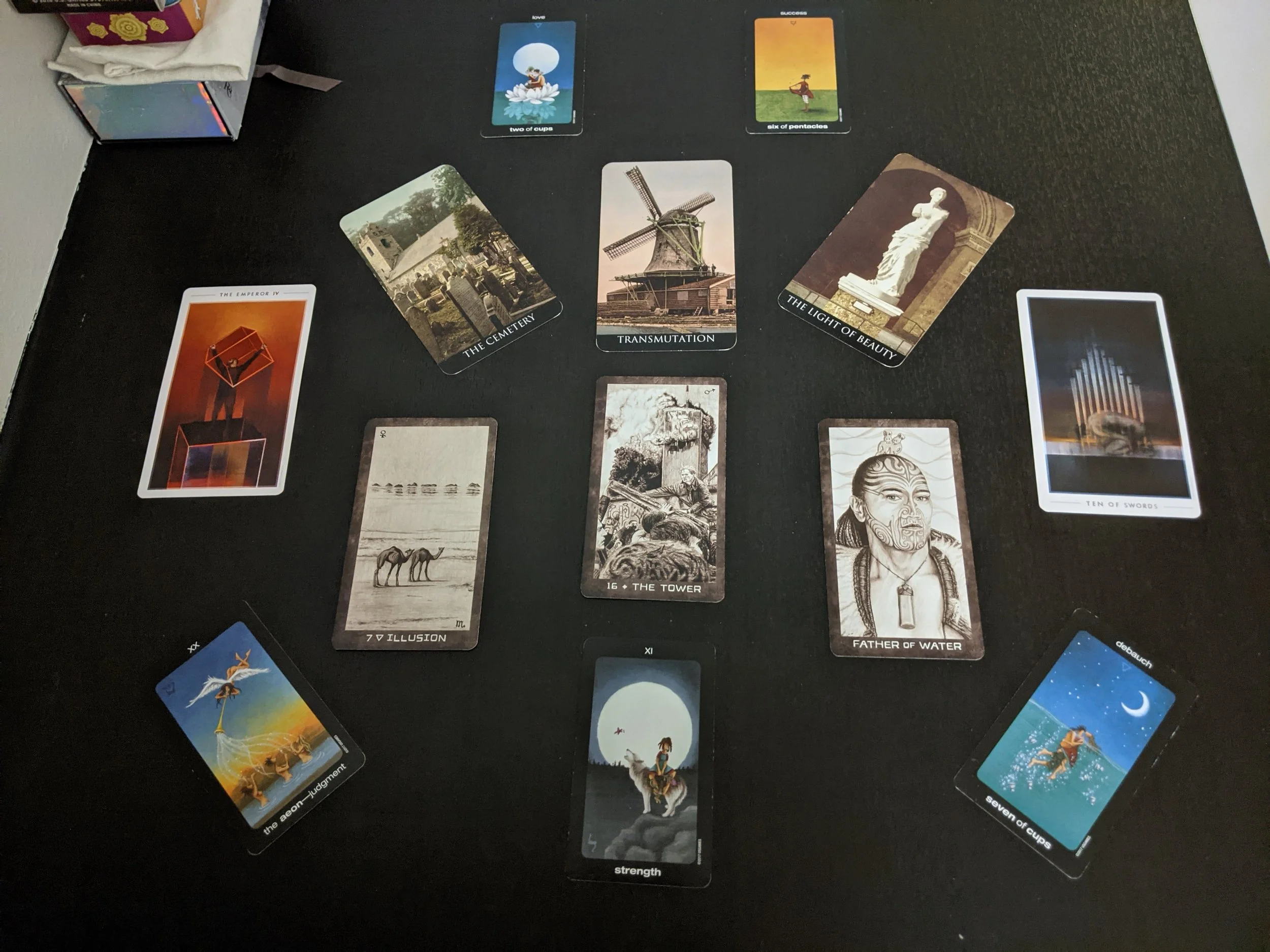
Another example, with multiple decks. This process can also be done with oracle cards.
When I do this alone, I usually have background music to accompany me, and it is a meditative journey that can take anywhere from 5 minutes to 2 hours. I don’t just stare at the cards the entire time, but also allow my body to freely move in the room as it wants or needs.
The process itself — of moving cards around, rearranging the constellation many times, while moving my physical body — is itself an act of embodied processing and energetic integration. I always feel clearer and more balanced inside afterwards. The insights that come from the final analysis and meaning reflection is mostly just a bonus. In this way, doing this practice hundreds of times, I came to know the book meanings of the tarot cards and system by heart as well.
Adding words to the constellation of images
This practice started out with just one tarot deck. It organically developed into multiple decks, combining with oracle and lenormand decks, and finally cards from multiple decks — ready to be combined with, or reintroduced to, words.
The example below is part of a series I did, of card + word combinations which told the story of an inner process in a non-linear, archetypal way, which I submitted as my graduation project for the Forest Therapy Guide training.
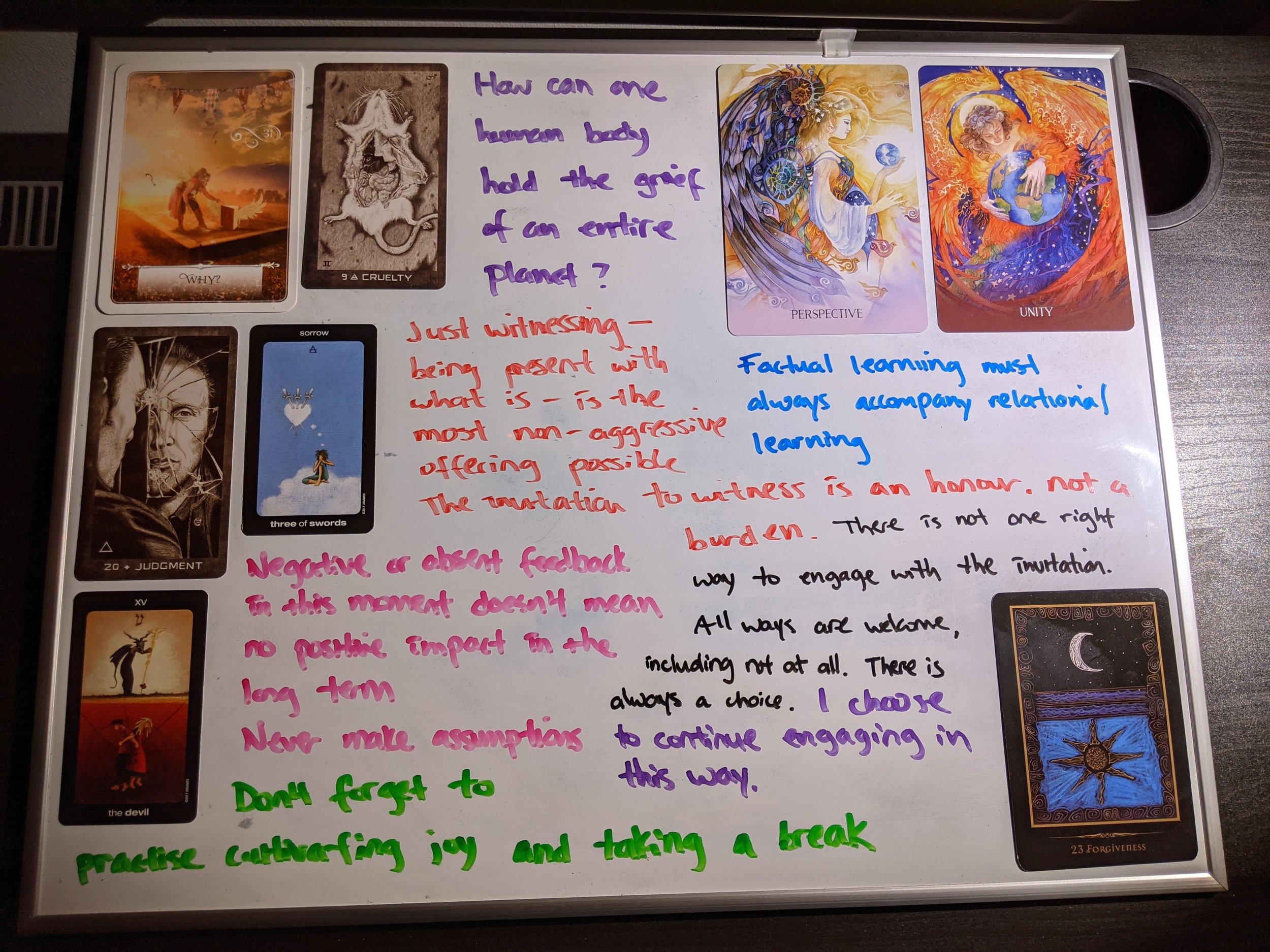
I do plan to post the entire series publicly one of these days.
Are you interested in learning to work with tarot cards as a self-inquiry practice?
I offer ongoing mentorship and customised guidance to support you in discovering the methods and processes that work best for you.
This can begin with a free, exploratory intro call. You can also book a reading with me, to experience how I read for others, and determine whether that is a way of reading which you want to learn to do as well.